World Cup 2026 Time Zone Guide: Navigating Match Times Across the USA, Mexico, and Canada
The 2026 FIFA World Cup is set to be the biggest sporting event in history. For the first time ever, three nations — the United States, Mexico, and Canada — will co-host the tournament, spanning an unprecedented 48 teams and 104 matches across 16 venues. With stadiums stretching from Vancouver to Mexico City and from Seattle to Miami, understanding the time zones involved is absolutely essential for fans planning to attend matches, watch from home, or follow the action from abroad.
This comprehensive World Cup 2026 time zone guide will help you make sense of it all.
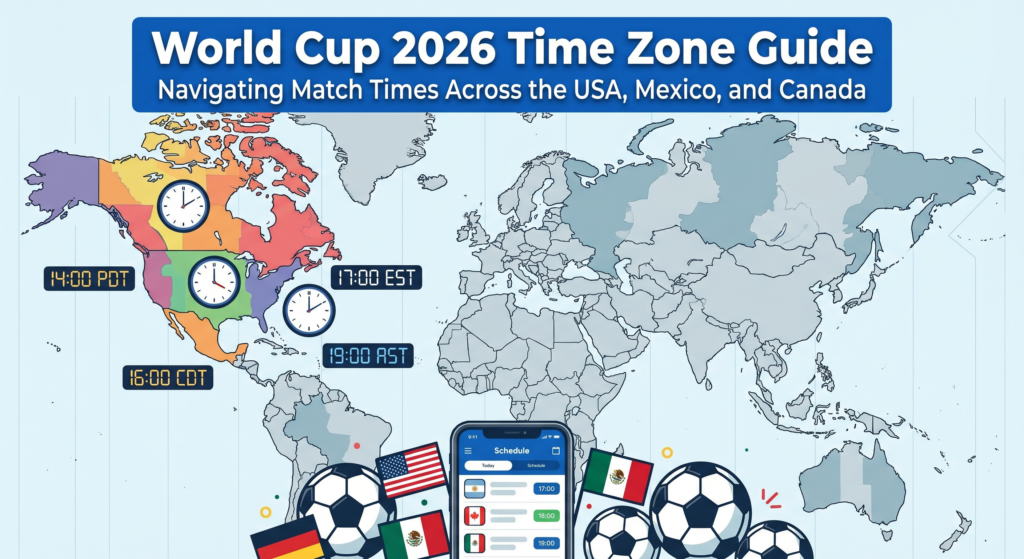
The Host Cities and Their Time Zones
The 2026 World Cup venues are spread across four major time zones in North America. Here’s how they break down:
Eastern Time (ET) — UTC-5 / UTC-4 (Daylight Saving)
Several key venues fall within the Eastern Time zone, which is also the most widely referenced time zone for US broadcasting:
- New York/New Jersey — MetLife Stadium
- Miami — Hard Rock Stadium
- Philadelphia — Lincoln Financial Field
- Atlanta — Mercedes-Benz Stadium
- Boston/Foxborough — Gillette Stadium
- Toronto — BMO Field (Canada)
Central Time (CT) — UTC-6 / UTC-5 (Daylight Saving)
The Central Time zone hosts some of the tournament’s most iconic venues:
- Houston — NRG Stadium
- Dallas — AT&T Stadium
- Kansas City — Arrowhead Stadium
- Mexico City — Estadio Azteca (Mexico)
- Monterrey — Estadio BBVA (Mexico)
- Guadalajara — Estadio Akron (Mexico)
Pacific Time (PT) — UTC-8 / UTC-7 (Daylight Saving)
The West Coast brings two major venues into play:
- Los Angeles/Inglewood — SoFi Stadium (expected to host the Final)
- Seattle — Lumen Field
- Vancouver — BC Place (Canada)
Mountain Time (MT) — UTC-7 / UTC-6 (Daylight Saving)
- San Francisco/Bay Area — Levi’s Stadium
This means there’s a three-hour difference between the earliest and latest time zones hosting matches during the tournament. When it’s 6:00 PM in New York, it’s only 3:00 PM in Los Angeles.
How Will Match Scheduling Work?
FIFA typically schedules World Cup matches in specific kickoff windows to accommodate both local fans and global television audiences. Based on previous tournaments and the unique challenge of multiple time zones, expect matches to be scheduled with the following considerations:
Group Stage Matches will likely have kickoff times staggered throughout the day. Early matches could begin as early as 11:00 AM or 12:00 PM local time, with evening matches kicking off around 6:00 PM or 7:00 PM local time. This means a 6:00 PM kickoff in Miami would be a 3:00 PM start for fans watching in Los Angeles — and an 11:00 PM or midnight start for European viewers.
Knockout Stage Matches tend to have fewer games per day, allowing FIFA more flexibility in choosing prime-time windows that balance local attendance with global viewership.
The Final, expected to be held at SoFi Stadium in Los Angeles (Pacific Time), will likely be scheduled for an afternoon or early evening local kickoff to accommodate European and Asian audiences watching in the late evening or early morning hours.
What This Means for International Fans
Europe (UK, Central Europe, Eastern Europe)
European fans will face some late nights. Matches played on the US East Coast during evening hours will land between 11:00 PM and 2:00 AM across Europe. West Coast evening games could push past 3:00 AM. Afternoon kickoffs in the US, however, will be much more manageable for European viewers, falling in the evening hours.
Asia and Australia
Asian fans might actually benefit from the North American time zones. Morning and early afternoon matches in the US will air during evening and late-night hours in countries like Japan, South Korea, China, and India. Australian fans can expect early morning viewing for many games.
South America and Africa
South American viewers will enjoy relatively convenient match times, with most games airing during afternoon and evening hours. African fans will have a similar experience to European viewers, with late-night matches being common for West Coast games.
Daylight Saving Time Considerations
The 2026 World Cup is scheduled to run from June 11 to July 19, 2026. During this period, all US, Canadian, and Mexican venues will be observing Daylight Saving Time. This is important for international fans calculating time differences, as the offset from UTC will be one hour ahead of standard time in each zone.
However, it’s worth noting that the future of Daylight Saving Time in the US remains a topic of legislative debate. If any changes occur before 2026, time calculations could shift accordingly. Stay updated as the tournament approaches.
Tips for Planning Your World Cup 2026 Schedule
- Use a world clock app that allows you to pin multiple cities so you can instantly see match times in your local zone.
- Download the official FIFA app once the schedule is released for automatic time zone conversions.
- Plan travel between venues carefully. Flying from an East Coast match to a West Coast match means gaining three hours, but jet lag can still affect your experience.
- Book accommodations early. Cities hosting multiple matches will see hotel prices skyrocket.
- Set calendar reminders with the correct time zone attached to avoid confusion.
Final Thoughts
The 2026 World Cup’s sprawling geography is both its greatest strength and its biggest logistical challenge. The time zone spread means that no matter where you are in the world, some matches will fall at convenient hours — and others won’t. But with a little planning and this guide in hand, you’ll be ready to catch every goal, every upset, and every unforgettable moment of what promises to be a truly historic tournament.
Start planning now. The world’s game is coming to North America, and the clock is already ticking.